TL;DR
Larnaca Airport to Ayia Napa, defined. The arrival leg for most package holidays to the Famagusta resorts. It is 59.6 km by road, effectively one motorway end to end, and it is served by a fixed statutory taxi fare, a direct pre-booked airport shuttle, a cheaper two-leg public bus through Larnaca town, and a large market of pre-booked private transfers.
- 59.6 km and about 51 minutes, measured over the road network on 8 September 2026.
- The taxi is a fixed statutory fare: EUR 50 by day, EUR 60 at night, up to four passengers. Luggage and VAT included, and the same on public holidays.
- The cheapest way is the public bus through Larnaca town, EUR 7.70 a head. The direct airport shuttle is EUR 13 a head.
- At four people the direct shuttle costs EUR 52 and the fixed-fare taxi costs EUR 50, so the bus stops being the cheap option.
- Protaras is a separate fare of EUR 55, more than Ayia Napa and the same as Limassol.
- Rents in Cyprus delivers cars to Ayia Napa. There is no counter in the town, and no published delivery charge for it.
On this page
How far is Ayia Napa from Larnaca Airport, and how long does it take?
59.6 km by road and about 51 minutes with no traffic. If you have read that it is 40 km, that figure is wrong by nearly twenty kilometres.
| From Larnaca Airport to | Road distance | Free-flow drive time |
|---|---|---|
| Ayia Napa (town centre) | 59.6 km | about 51 minutes |
| Protaras | 67.8 km | about 60 minutes |
Measured over the road network on 8 September 2026, from the terminal at 34.8751, 33.6249 to the centre of Ayia Napa at 34.9884, 33.9994, the driving distance is 59.6 km and the free-flow time is 51 minutes. Protaras, a little further up the coast, is 67.8 km and about an hour.
This is worth stating plainly because Google's own AI Overview currently answers this question with "about 40 minutes over a 40 km distance". That is not a rounding difference. It is nineteen kilometres short, and it contradicts a page ranking on the same results screen: MyTransfers publishes 59.06 km, which is within half a kilometre of my own measurement.
The practical consequence is small but real. At 40 km you might reasonably think about walking part of it, or expect a EUR 30 fare. At 59.6 km neither is true, and the fixed fare below is what it is because of the real distance.
How much is a taxi from Larnaca Airport to Ayia Napa?
EUR 50 by day and EUR 60 at night for up to four passengers. It is a fixed statutory fare, not a meter reading and not an estimate.
| From Larnaca Airport to | Day, up to 4 | Night, up to 4 | Day, 5 to 6 | Night, 5 to 6 |
|---|---|---|---|---|
| Agia Napa | EUR 50 | EUR 60 | EUR 65 | EUR 80 |
| Protaras | EUR 55 | EUR 65 | EUR 75 | EUR 85 |
| Limassol | EUR 55 | EUR 65 | EUR 70 | EUR 85 |
| Larnaca (Dhekelia, Pyla, Alaminos) | EUR 25 | EUR 25 | EUR 30 | EUR 30 |
The fare is set by a statutory instrument, K.D.P. 79/2021, published in the Official Gazette No. 5463 of 19 February 2021 and in force since 1 March 2021. It fixes fares for hires made from and to the airports. Larnaca Airport to Agia Napa is EUR 50 by day and EUR 60 at night for a taxi carrying up to four passengers, and EUR 65 by day and EUR 80 at night for one carrying five or six.
Day means 06:00 to 20:30 and night means 20:30 to 06:00. The instrument says in terms that the fixed fares include VAT and the cost of luggage carriage, and that they also apply on public holidays. So there is no per-bag charge, no holiday surcharge, and no reason for the number to move.
Two things follow that are not published anywhere else on this search. Protaras is a different and higher fare, EUR 55 by day, which is the same as Larnaca Airport to Limassol even though Limassol is 7.5 km further. And because the instrument covers hires from and to the airports, the return leg is the same fixed fare in reverse.
This is the part the rest of the search gets wrong. Google's AI Overview gives a range of EUR 45 to EUR 60, and its low end is below the legal fare. A page ranking for the neighbouring Limassol route describes the fixed fare as a "metered fare", which it is not. A journey that starts in Larnaca town rather than at the airport is a different matter: no fixed fare covers it, and the metered urban tariff applies.
A fixed fare is not a starting price
Is there a bus from Larnaca Airport to Ayia Napa?
Yes, and there are two different ways to do it: a direct pre-booked shuttle at EUR 13 a seat, or a change in Larnaca town for EUR 7.70.
| How | Fare, per person | Where you board |
|---|---|---|
| Kapnos Airport Shuttle, direct | EUR 13 | The terminal, pre-booked seat |
| Route 425 then the intercity bus | EUR 7.70 | The terminal, then change in Larnaca town |
The direct option is the Kapnos Airport Shuttle, which runs from the terminal itself on a pre-booked seat at EUR 13 a person, read from the operator's own posting on 8 September 2026. It is the simplest thing to do with luggage and a tired child, and it is the option most guides name.
The cheaper option is a change. Urban route 425 runs from the terminal into Larnaca town at EUR 2.70, and the intercity service from the town to Ayia Napa is EUR 5, which is EUR 7.70 in total. The intercity leg runs about seventeen times a day from the town, so the connection is not a once-a-day gamble.
The distinction that matters, and that the search results blur, is that no intercity bus leaves the airport. When a page tells you the Larnaca to Ayia Napa bus is EUR 5, it is describing a bus you board in the town centre, not at the terminal. Getting to that bus is the EUR 2.70 leg.
What all four options actually cost
Priced from the statutory instrument, the operators' own published fares, dated transfer observations and our own dated rate card, for one, two and four people.
This journey, priced four ways for 1, 2 and 4 people
| Party of | Taxi, day, per car | Bus, party total | Transfer, observed | Hire from us, 3 days | Hire from us, 7 days |
|---|---|---|---|---|---|
| 1 | €50 | €13 (€13 each) | €74 for 4 (Kiwitaxi, 8 September 2026) | €126.12 plus delivery | €251.12 plus delivery |
| 2 | €50 | €26 (€13 each) | €74 for 4 (Kiwitaxi, 8 September 2026) | €126.12 plus delivery | €251.12 plus delivery |
| 4 | €50 | €52 (€13 each) | €74 for 4 (Kiwitaxi, 8 September 2026) | €126.12 plus delivery | €251.12 plus delivery |
| Option | Cost, one way | What kind of figure this is |
|---|---|---|
| Taxi | €50 | fixed fare, up to 4 passengers, day 06:00 to 20:30 |
| Bus | €26 (€13 × 2) | operators' published fares, per person |
| Pre-booked transfer | €74 for 4 (Kiwitaxi, 8 September 2026) | seller's route page, from-price for a four-seat car |
| Hire from us | €126.12 plus delivery, which we quote when you book | Nissan March, 3 days × €40 = €120; delivery to Ayia Napa is charged and we quote it when you book; it is not published, so no total is printed here; fuel at €1.709 a litre, the dearest Paphos station on 8 September 2026: 3.58 l = €6.12 |
Lowest figure for this journey: Bus, €26. For this party and this length the hire car is not the lower figure. That is the honest answer, and the taxi or the bus is the right call.
Nothing here is a quote or a hold. Exact dates are priced on the reservation page, and nothing is reserved until we confirm. Check availability for your dates
Nothing in this table is a quote or a hold: it is dated published figures and our own dated rate, and exact dates are priced on the reservation page. Other journeys, party sizes and hire lengths are on the Cyprus route cost comparator.
The transfer column is a dated observation rather than a price I can vouch for. On 8 September 2026 Kiwitaxi published EUR 74 for a four-seat car on this route and Holiday Extras described a private taxi transfer as costing around GBP 66.48 for four people. Both are above the statutory taxi fare for the same journey in the same car.
That is the single most useful thing on this page. A pre-booked transfer for four is being sold at roughly one and a half times a fare that is fixed by law and that you can simply ask for at the rank.
The road, and the British base area you drive through
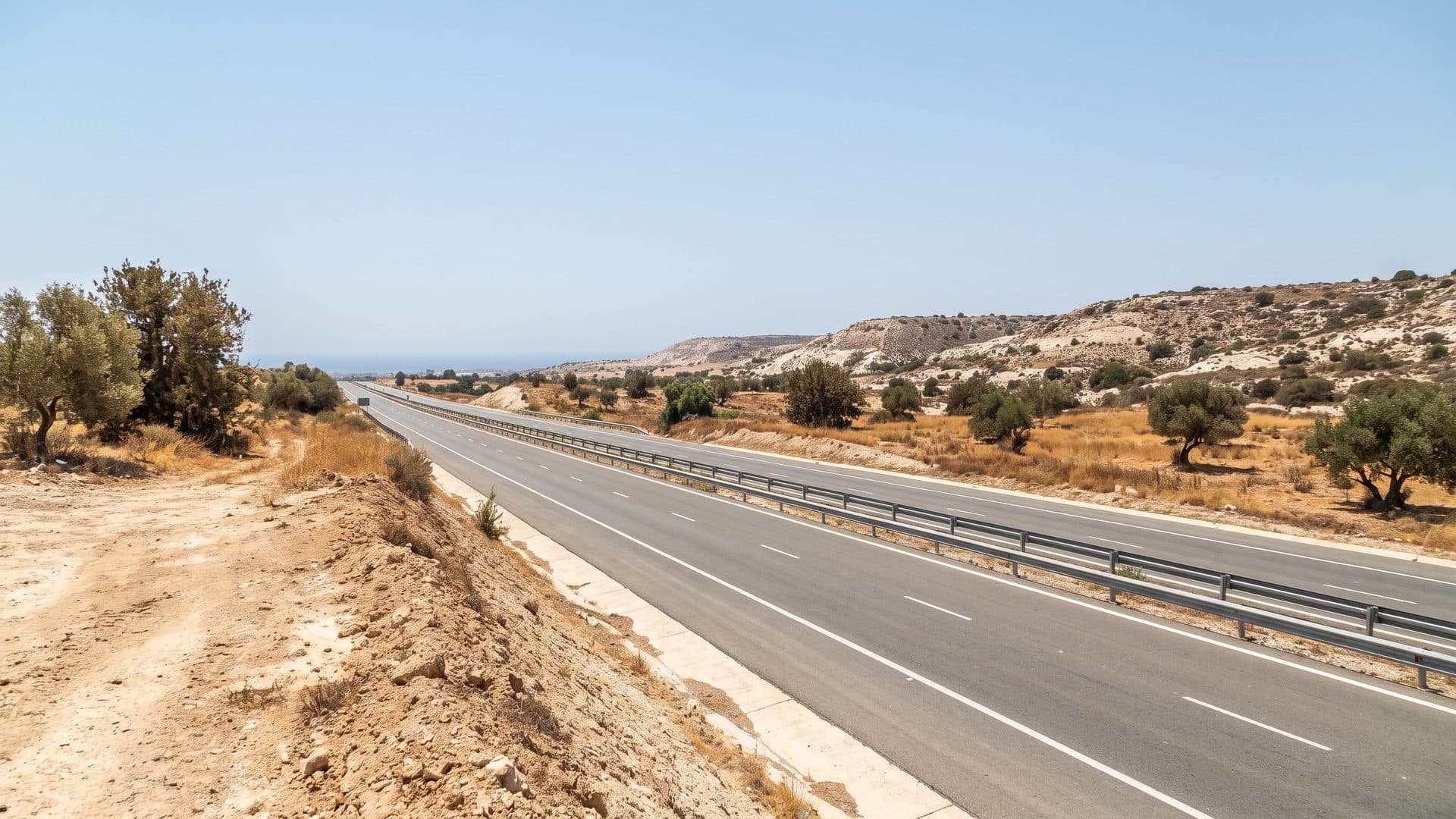
53.7 of the 59.6 km are the A3, and part of it crosses the Dhekelia Sovereign Base Area, which is British territory with its own police force. Every speed limit there is the same number as in the Republic.
| Limit | Republic of Cyprus | Dhekelia Sovereign Base Area |
|---|---|---|
| Built-up areas | 50 km/h | 50 km/h |
| Other roads | 80 km/h | 80 km/h |
| Motorway maximum | 100 km/h | 100 km/h |
| Motorway minimum | 65 km/h | 65 km/h |
The route is about as simple as a Cyprus drive gets. Two kilometres of Artemidos Avenue out of the airport, then 53.7 km of the A3, the Larnaca to Ayia Napa motorway, then a couple of kilometres of town road at the far end. One road, one direction, no junction you can plausibly miss.
What the road does that is worth knowing is cross the Dhekelia Sovereign Base Area. That is not a metaphor: the Eastern Sovereign Base Area is British sovereign territory covering 50.5 square miles, and the A3 passes through it on the way east. You will not notice. The Sovereign Base Areas Administration describes the traffic through its own territory as through-traffic, and states that there are no controlled borders between the Sovereign Base Areas and the Republic. There is no checkpoint and no sign asking for a document.
Two things do change, and neither is a reason for concern. Policing is by the Sovereign Base Areas Police Service, an independent force established in 1960 with jurisdiction under Sovereign Base Areas law rather than the Republic's, staffed almost entirely by locally recruited Greek and Turkish Cypriots. And the road law is the base areas' own, the Motor Vehicles and Road Traffic (Consolidation) Ordinance 2006.
The reassuring part is that the numbers are identical. That Ordinance sets 50 km/h in built-up areas, 80 km/h on other roads, 100 km/h on a motorway and a 65 km/h motorway minimum, which are the same four figures the Republic uses. Nothing on your speedometer needs to change as you cross.
The difference is in the currency of the penalty rather than in the thresholds, and the thresholds turn out to be the same three. Both jurisdictions band speeding at 30, 50 and 75 per cent over the limit. The Republic prices each band in money: 2 euros per km/h up to 30 per cent, 3 euros to 50, 5 euros to 75, and court above that. The base areas pay the same three bands in licence points: nought to two up to 30 per cent, two to four from 31 to 50, three to six from 51 to 75.
One thing I could not establish, and would rather say so than guess: whether a Cyprus hire-car insurance policy is written to name the Sovereign Base Areas. No published policy wording I could find addresses it either way. This is not the Green Line, where the position is documented and your Republic insurance genuinely stops. The base areas sit inside the island's ordinary road network with no border and no crossing formality. If it matters to you, ask whoever you hire from to confirm it in writing.
The rules of the road themselves, signs, limits, licences, alcohol and what a hire car is and is not covered on, are all on our driving in Cyprus guide, which is where they belong rather than repeated here.
Which one is actually worth it, by party size
The bus for one or two. A close call at three. The fixed-fare taxi from four people up, and from any party landing after 20:30 with luggage.
| Party | Cheap bus, total | Direct shuttle, total | Fixed-fare taxi | Cheapest |
|---|---|---|---|---|
| 1 person | EUR 7.70 | EUR 13 | EUR 50 | Bus |
| 2 people | EUR 15.40 | EUR 26 | EUR 50 | Bus |
| 4 people | EUR 30.80 | EUR 52 | EUR 50 | Bus, but only the two-leg one |
| 6 people | EUR 46.20 | EUR 78 | EUR 65 | Bus, and the taxi is EUR 19 behind it |
This route has an unusually clean crossover, because the bus is sold per seat and the taxi is sold per car. Multiply the seat price by the party and the answer changes at four.
For one person the two-leg bus is EUR 7.70 against EUR 50, and there is no argument. For two it is EUR 15.40 against EUR 50, and still none. For four the two-leg bus is EUR 30.80, which is still cheaper, but the direct shuttle is EUR 52 and the taxi is EUR 50, so the convenient bus has become the expensive option while the cheap bus involves shepherding four people and their cases through a change in Larnaca town.
For five or six the two-leg bus is still the cheapest at EUR 46.20, but the taxi fare only rises to EUR 65, so the gap has closed to about EUR 19 for the whole party. That is EUR 19 to avoid moving six people and their luggage between two buses, which is the first point on this route where paying more is easy to defend. The direct shuttle is the option that stops making sense: at EUR 78 for six it costs more than the taxi and leaves you further from the door.
The hire car is a different decision and not really a competitor on this leg. Sixty kilometres of motorway is about EUR 6 of fuel one way, so the drive itself is nearly free; what you are paying for is the car for the week and the ability to leave the resort. If you intend to spend the week in Ayia Napa and walk to the beach, you do not need it. If you intend to see Cape Greco, Protaras and the Famagusta villages, the bus network will not take you and the taxi fares are not fixed once you leave the airport.
Landing at Larnaca and heading somewhere else? I have measured the other two runs from the same terminal the same way, from the same instrument and the same coordinates: Larnaca Airport to Limassol is 75.3 km at a fixed EUR 55, and Larnaca Airport to Paphos is 134.3 km at a fixed EUR 105, the longest of the three runs out of this terminal that we cover, and the one where the bus question changes shape entirely.
What Rents in Cyprus does at the Ayia Napa end, and what it does not
I am a manager at Rents in Cyprus LTD, which hires cars in Ayia Napa by delivery. There is no counter in the town, no desk in the airport arrivals hall, and no published delivery charge for either.
It is worth being exact about this, because every other page you will read on this route is selling something at both ends and this one is not.
The company hires cars across the island, Ayia Napa included. What it has in Ayia Napa is delivery to an address you give, not a counter you walk up to. Its own handover points are in the Paphos area and in Limassol; Larnaca, Nicosia and Ayia Napa are served by bringing the car to the customer.
The delivery charge for Ayia Napa is not published, and that is a deliberate absence rather than an oversight. Delivery is free across the Paphos area and in Limassol. No figure has been set for the three delivery cities, so it is quoted when you ask rather than printed as a number the company would then have to stand behind. That is also why the hire column in the table above prints no total for this route while it prints one for journeys that start at a handover point.
Two other things catch people out. Returns are same-town only: there is no one-way between any two of the company's cities, and a return to the wrong location is charged from EUR 300, which is the single most expensive assumption anyone makes about it. And a car brought to Ayia Napa is on the Paphos card at Paphos rates, with a one-day minimum hire.
No counter, no availability claim
Before you land
Five things worth settling before the plane doors open, because all five are harder to fix in the arrivals hall.
- Count your party. Four is the number where the per-seat shuttle stops being cheaper than the per-car taxi.
- Check your landing time. The statutory night fare starts at 20:30 and runs to 06:00.
- If you want the public bus, you are changing in Larnaca town. There is no intercity departure from the terminal itself.
- If you are heading to Protaras rather than Ayia Napa, it is a different fixed fare and a different bus stop.
- If you want a car, decide whether you want it from the airport or delivered later in the week. There is no one-way return.
Where these figures come from
Every fare, distance and rule on this page was read on 8 September 2026, and the source sits at the claim rather than in a list here.

Written by Paul Bendzik, a manager at Rents in Cyprus, based in Limassol.
Manager at Rents in Cyprus. Writes the driving and hire guides.
The taxi fares are a statutory instrument, K.D.P. 79/2021, read in full from the airport operator's own published copy on 8 September 2026 and carried as current by the Road Transport Department. Its Larnaca Airport block holds eleven rows, and the two used here are Agia Napa and Protaras. The bus fares come from the operators' own published pages and posts, read 3 to 8 September 2026; any of them may change a schedule without notice. The base area speed limits and penalty bands are section 4 and the penalty-points schedule of the Motor Vehicles and Road Traffic (Consolidation) Ordinance 2006, consolidated text revised 25 July 2025, published by the Sovereign Base Areas Administration. The distances are my own measurement over the OpenStreetMap road network from published coordinates: the terminal at 34.8751, 33.6249, Ayia Napa at 34.9884, 33.9994 and Protaras at 35.0125, 34.0583. Our own rates come from the company's own price card dated 26 August 2026. Aggregators, transfer sellers and taxi firms are named and dated and never linked.