TL;DR
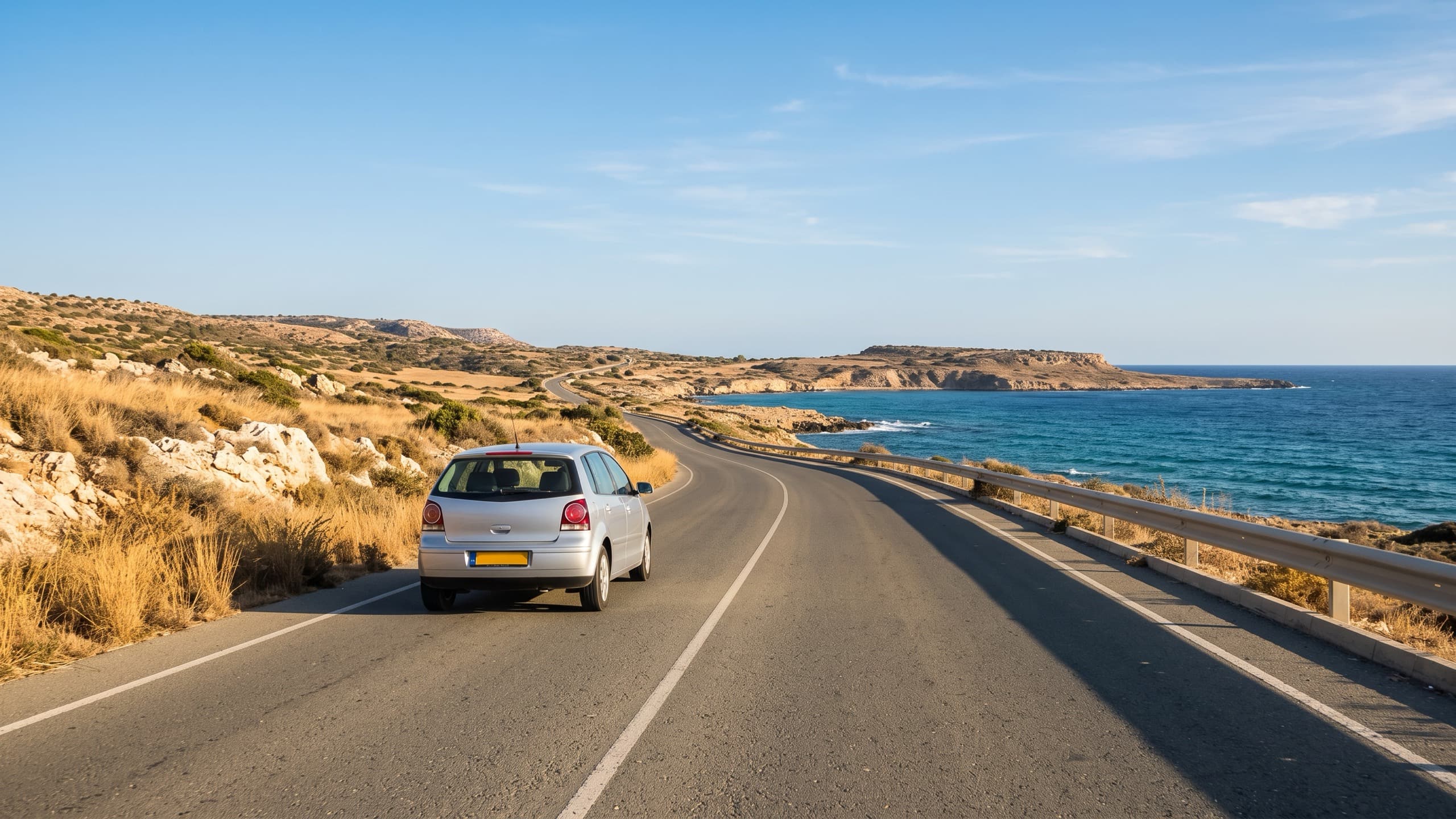
Driving in Cyprus, defined. Cyprus is a left-hand-traffic country with EU-style signs in Greek and English. Its roads run from a small modern motorway network down to unsealed forest tracks. Four national speed limits apply, the alcohol limit is lower than England's, and how long you may drive on your own licence depends on the country that issued it.
- The network is about 2,450 km of maintained main road, of which 257 km is motorway, and roughly 5,150 km more of rural and forest road where the tarmac can stop.
- You drive on the left and overtake on the right, in a right-hand-drive car.
- Speed limits are 50 km/h in built-up areas, 80 on rural roads and 100 on motorways, which also carry a 65 km/h minimum.
- The breath-alcohol limit is 22 micrograms per 100 millilitres. That is Scotland's limit, not England's.
- An EU licence or a UK photocard needs no international permit. Most non-European licences are good for 30 days, and sixteen named countries get six months.
- Speeding is priced per km/h over the limit, from 2 euros per km/h.
- Your Republic of Cyprus insurance stops at the Green Line, and the cover sold at the crossing is third-party only.
- A hire car here is an asphalt-only vehicle: off-road use is charged at 450 euros a violation on a standard car and 600 euros on an SUV, plus 20 to 30 euros per kilometre, and the damage waiver excludes it.
On this page
What are the roads in Cyprus actually like?
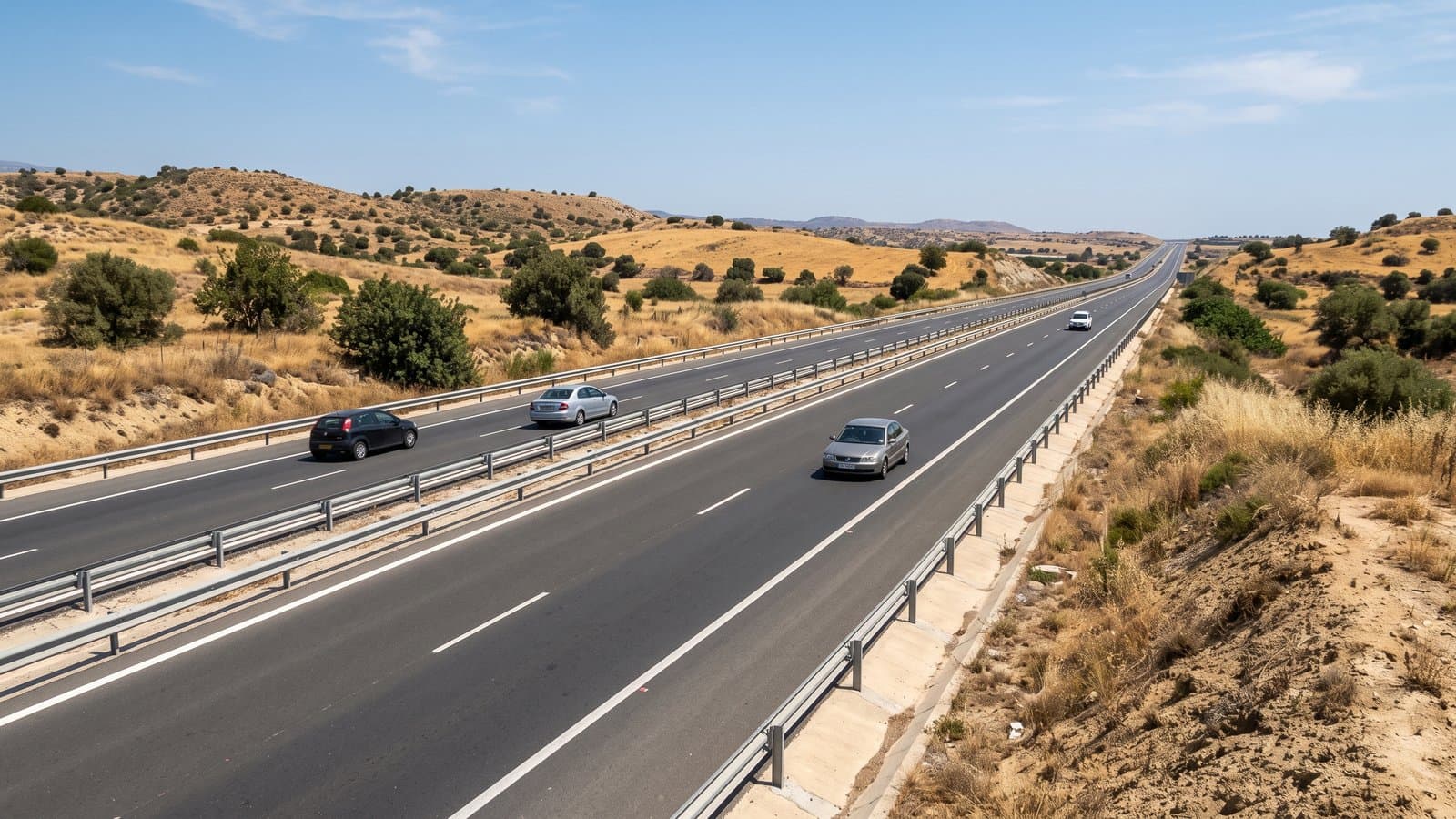
Three tiers, and the difference between them is the answer. A small modern motorway network joins the towns, a much larger maintained main-road network sits under it, and larger again is a web of rural and forest road that a hire car has no business on.
| Road class | Length | Who maintains it |
|---|---|---|
| Motorway | 257 km, of which 182 km is on the EU TEN-T network | Public Works Department |
| Main road network, the 257 km of motorway included | About 2,450 km | Public Works Department |
| Urban, rural and forest roads | About 5,150 km | Municipal authorities, regional authorities and the Forestry Department |
The government's own line, in the road-safety leaflet it hands to visitors, is that Cyprus has a modern and efficient road system that enables easy travel between all major towns and many places of interest. For the road between the towns, that is fair. The motorways are dual carriageway, well surfaced, and quiet by British standards.
What the sentence does not tell you is how small that part of the network is. Set the two figures side by side and roughly two thirds of the road length on this island is not maintained by the roads department at all. It belongs to municipalities, to regional authorities and to the Forestry Department, and the last of those is exactly what it sounds like.
The department that builds and maintains the motorways and the main roads is the Public Works Department, which has been doing it since 1878 and now sits under the Ministry of Transport, Communications and Works. Its own description of what it looks after is motorways and other primary and secondary roads. Everything after the word secondary belongs to somebody else, and that is where the surface changes.
Now the part where the published record falls apart, because you will meet both of these numbers and they do not agree. Wikipedia gives 7,206 km paved and 4,387 km unpaved, which is a 2002 census figure still being quoted twenty-four years later. Autotraveler gives 13,006 km total and 8,564 km paved, and that is the page Google's own AI Overview cites when it tells you how big the network is, observed 3 September 2026. Neither is a government source and neither carries a recent date, so I use the Public Works Department's own breakdown above and tell you the others exist. Do not average them: they are counting different things.
What survives all three versions is the ratio, and the ratio is the point. Whichever figures you take, a large minority of the road length on this island is not sealed. That is a fact about your hire agreement before it is a fact about geography.
So the practical version, for a week with a hire car: the roads you have planned to drive are good, and the roads you find on the way to a beach may not be. The rest of this page is about telling the two apart before you are on one.
Two questions this raises and does not answer. If you want one of those cross-island drives described end to end, with the distances and where it is worth stopping, the Paphos to Ayia Napa route guide does that run in full, and the drive from Larnaca to Paphos covers the crossing most visitors actually make, with the road named and the distance measured. Paphos to Limassol is the A6 on its own, which is the stretch of motorway most people here drive most often. And if you are still deciding whether these roads are worth a car at all, the case for and against renting one in Cyprus sets the cost against the buses and the taxis.
Are there tolls on Cyprus motorways?
Nobody who publishes an answer agrees with anybody else who publishes one, and none of them is a government source. Here are all five, dated, so you can see the state of it rather than take my word for it.
| Who says it | What they say | Observed |
|---|---|---|
| RAC | Cyprus has no toll roads | 12 August 2026 |
| Auto Europe | Cyprus has no toll roads | 12 August 2026 |
| Orbit Car Hire | Tolls on the A1 and A2, collected by an electronic device | 12 August 2026 |
| Wikipedia | There are no toll paying roads in Cyprus | 3 September 2026 |
| Autotraveler | There are no toll roads in Cyprus | 3 September 2026 |
| TollGuru | Small tolls on parts of the main corridors, paid at a booth | 3 September 2026 |
Google has picked the outlier. Its AI Overview for this query tells searchers that small tolls are paid at booths on the main corridors, sourcing that to TollGuru, while three references further down the same answer it cites a page stating there are no toll roads in Cyprus at all. Observed 3 September 2026.
I have not found a government page that settles it, so I am not going to settle it either. Publishing a sixth confident answer on top of five that disagree is how this particular mess got made.
What I will tell you is what to do about it. Budget for fuel rather than tolls, carry a card in case you meet something nobody has documented, and treat an actual toll gantry as news worth telling us about. The moment a gov.cy source states a position, this section gets a figure and a date and stops being a survey.
Which side of the road do you drive on in Cyprus?
The left, and you overtake on the right. A British or Irish driver can land here and drive without rewiring anything.
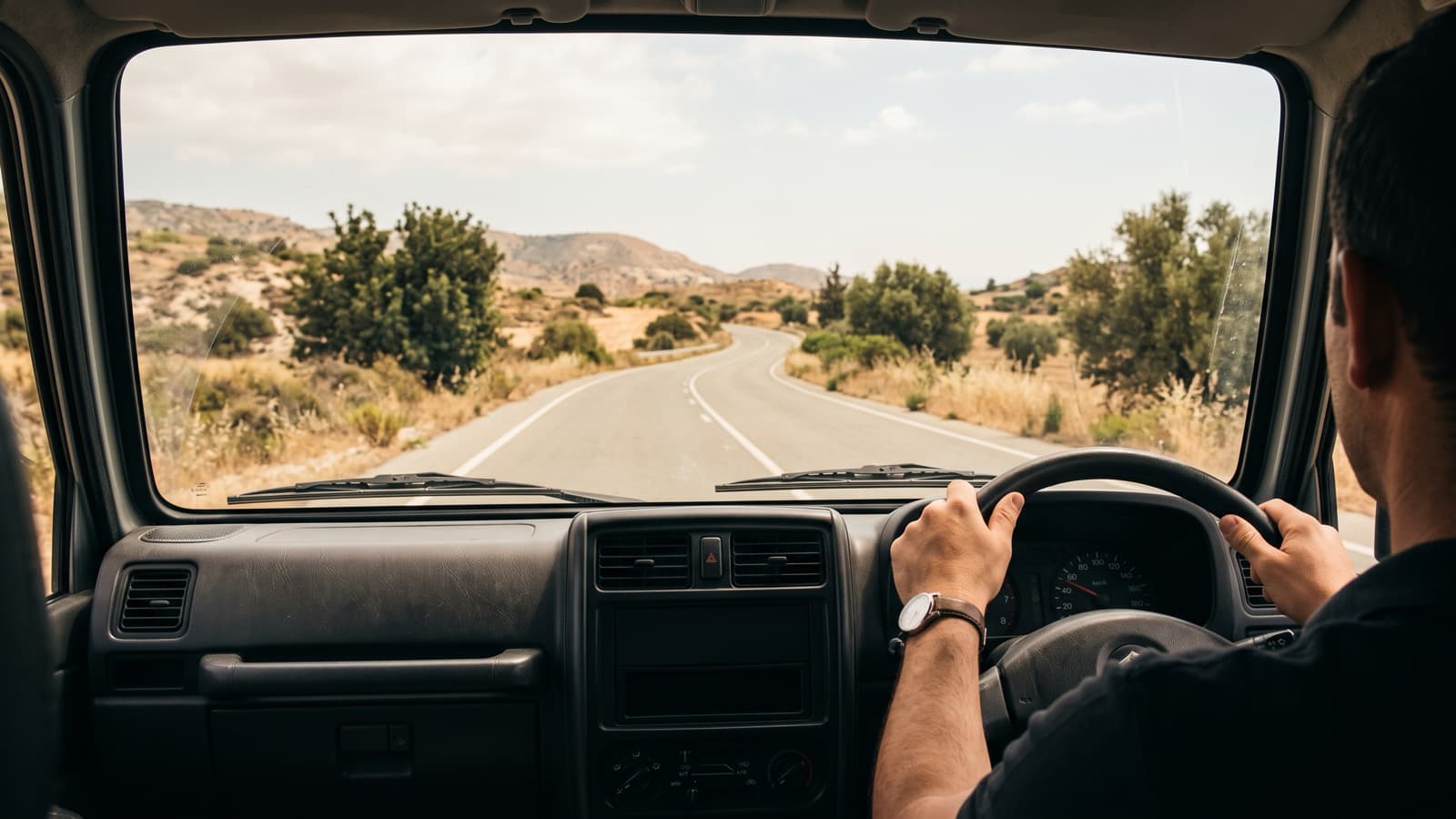
What catches UK drivers out is not the side. It is the right turn across oncoming traffic, and the hand that now works the gear lever. Both feel wrong for about a day.
The reason is administrative rather than cultural. The island was under British administration until 1960, and the traffic rule stayed. The government road-safety leaflet states it in capitals, which tells you how often visitors get it wrong.
One local detail worth knowing before you pull out of the hire car park: cars on hire here carry red number plates. Every driver around you can see you are new to the island. Take the courtesy that comes with that, and expect to be overtaken.
If you drive an automatic at home, book an automatic. Changing gear with the other hand while turning across traffic is not the skill to learn on holiday.
Cyprus speed limits, and what going over actually costs
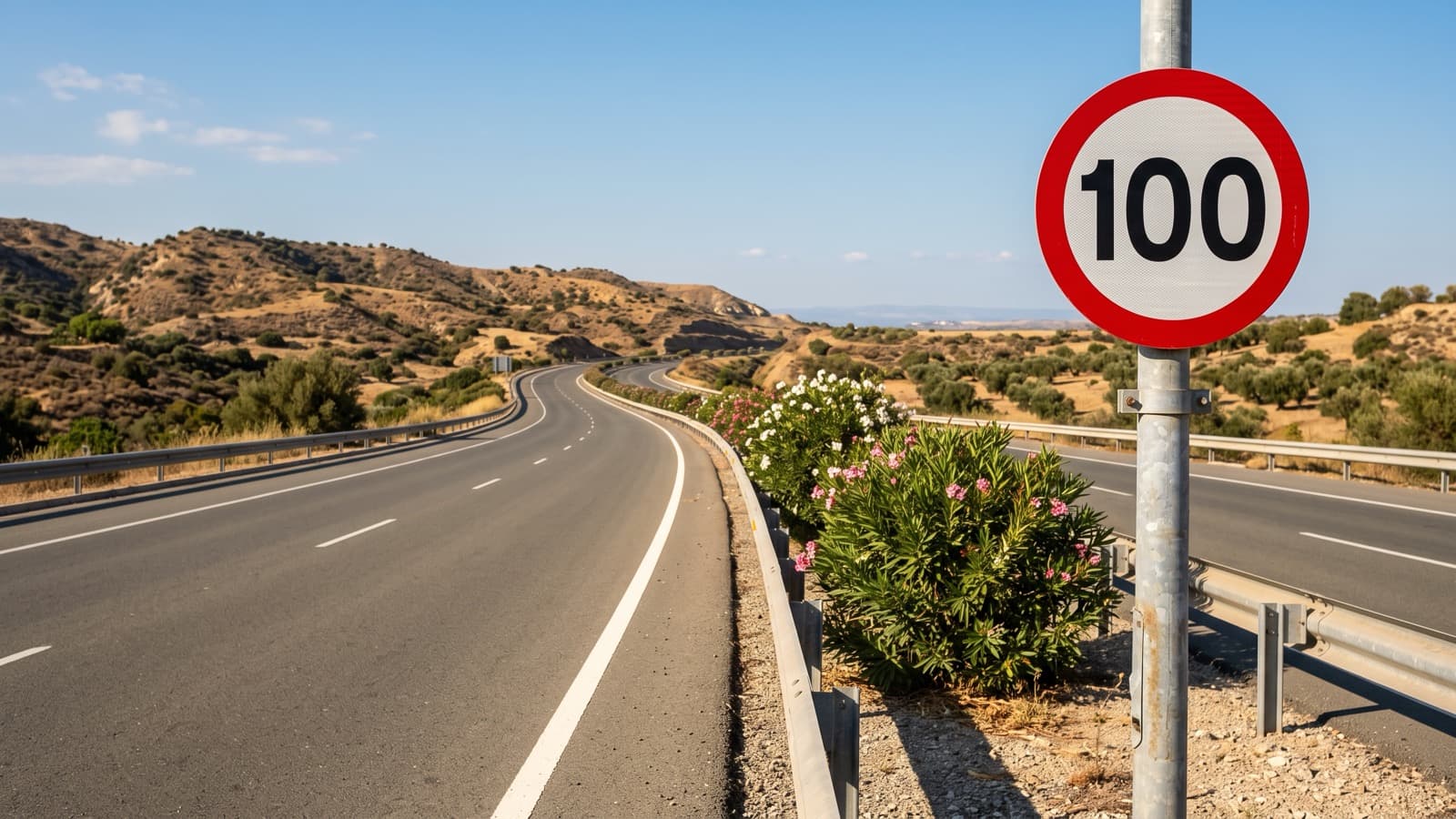
Four numbers, and one of them is a floor rather than a ceiling.
| Road type | Limit |
|---|---|
| Built-up areas | 50 km/h maximum |
| Rural and inter-urban roads | 80 km/h maximum |
| Motorways | 100 km/h maximum |
| Motorways | 65 km/h minimum |
Read that last row again. Cyprus motorways carry a minimum speed of 65 km/h, which almost no British driver expects. Sitting at 55 in the left lane is itself an offence.
One thing the table cannot show you, and it is the most-asked motorway speed question in the Cypriot forums: the 100 is a national default, not a continuous limit. Stretches of motorway are posted lower, and drivers regularly report an 80 through the Limassol flyovers with no obvious point at which it lifts again. No government source publishes a schedule of posted limits, so I am not going to give you one. Carry the rule instead: the sign beats the table, every time, and the settlement is priced from the first kilometre over whichever number is on the sign.
Speeding is priced per kilometre over, not in flat bands. The Road Safety Cyprus penalty tables set the out-of-court settlement at 2 euros per km/h up to 30% over the limit. It rises to 3 euros per km/h up to 50%, and 5 euros per km/h up to 75%. Above that you go to court, and penalty points attach on top.
So 20 km/h over an 80 limit is a 40 euro settlement, not a fixed ticket. The arithmetic is the deterrent.
Two caveats on those figures. The government penalty page carries a last-updated stamp of 16 September 2020, which I would rather tell you than hide. And RAC publishes 1 euro per km/h for that first band where the government table says 2, checked 12 August 2026. Where a broker and a government source disagree, I follow the government.
The drink-drive limit is lower than England's, and lower again for new drivers
50 milligrams of alcohol per 100 millilitres of blood, or 22 micrograms per 100 millilitres of exhaled air. Both figures come from the road-safety leaflet. The second one decides your evening.
A roadside test measures breath. So 22 micrograms is the figure that actually gets applied to you, and it appears on none of the five best-ranked pages for this topic.
Here is where the internet has gone wrong. Several rental brokers publish 0.049% or 49mg per 100ml, and Google's own AI Overview now repeats it. That is a rounding artefact of a broker's page, not the law. The government leaflet is unambiguous, and it is free to read.
For a UK reader the anchor is simple: this is Scotland's limit, not England's. If you drive home from a pub in England on one pint without thinking about it, that habit does not travel.
A lower threshold applies to novice and professional drivers, and the two-tier structure shows up in the government's own court thresholds. I have seen a figure quoted for that lower tier in secondary sources, and I am not printing it, because no primary source confirms it. If you have held your licence under three years, assume the stricter number and drink nothing.
Random breath testing is permitted without any suspicion of an offence. Combined with per-kilometre pricing on everything else, one glass here is a decision rather than a rounding error.
What licence do you need to drive in Cyprus?
Usually the one already in your pocket. What varies is how long it lasts.
| Where your licence was issued | How long you may drive on it |
|---|---|
| EU or EEA country | Your own national licence, no time limit stated |
| Norway, Iceland, Liechtenstein, Australia, Russia, Georgia, Ukraine, Serbia, Switzerland, Zimbabwe, USA, Japan, Canada, New Zealand, South Africa, South Korea | Up to six months, then a Cypriot licence without a test |
| Any other non-European country | A maximum of 30 days on your national licence, or a valid international driving permit |
| United Kingdom | A photocard licence is accepted. A paper licence may need updating or an IDP |
That 30-day rule is the biggest hole in the published advice on this subject. Auto Europe tells readers an international driving permit is required by everyone, which is wrong. Sixt says all national licences are accepted, which is incomplete. RAC says you do not need an IDP, true for its British audience and read as universal. Observations all dated 12 August 2026.
Now the two ages that get blurred everywhere. Eighteen is the law. Twenty-one is the hire desk. Every published source I checked puts the legal minimum at 18, and I will be straight with you about the sourcing: the government leaflet sets out the licence rules without stating that number, so 18 is the consistent reading of the market rather than a line I can point you to on a government page. A rental company then sets its own minimum by contract, commonly 21, and often adds a requirement that you have held the licence for two or three years. A surcharge for drivers under 25 is usual.
Neither the age nor the surcharge is a statute you can look up, which is exactly why you should read the agreement rather than a guide. Rentals in Cyprus states its own age and licence conditions beside the rates on car hire in Paphos, where the rate and the excess sit together. Ask them to confirm both for your dates.
For a buggy or a quad the question changes from how old you are to which licence category you hold, and that has its own answer. A dedicated guide to buggy and quad licence rules is planned and not yet published.
Where the tarmac ends, and what your hire agreement says about it
The surface changes with the class of road rather than with the map, and the moment it changes you are usually outside what your rental cover pays for. That makes it a money question, not a comfort one.
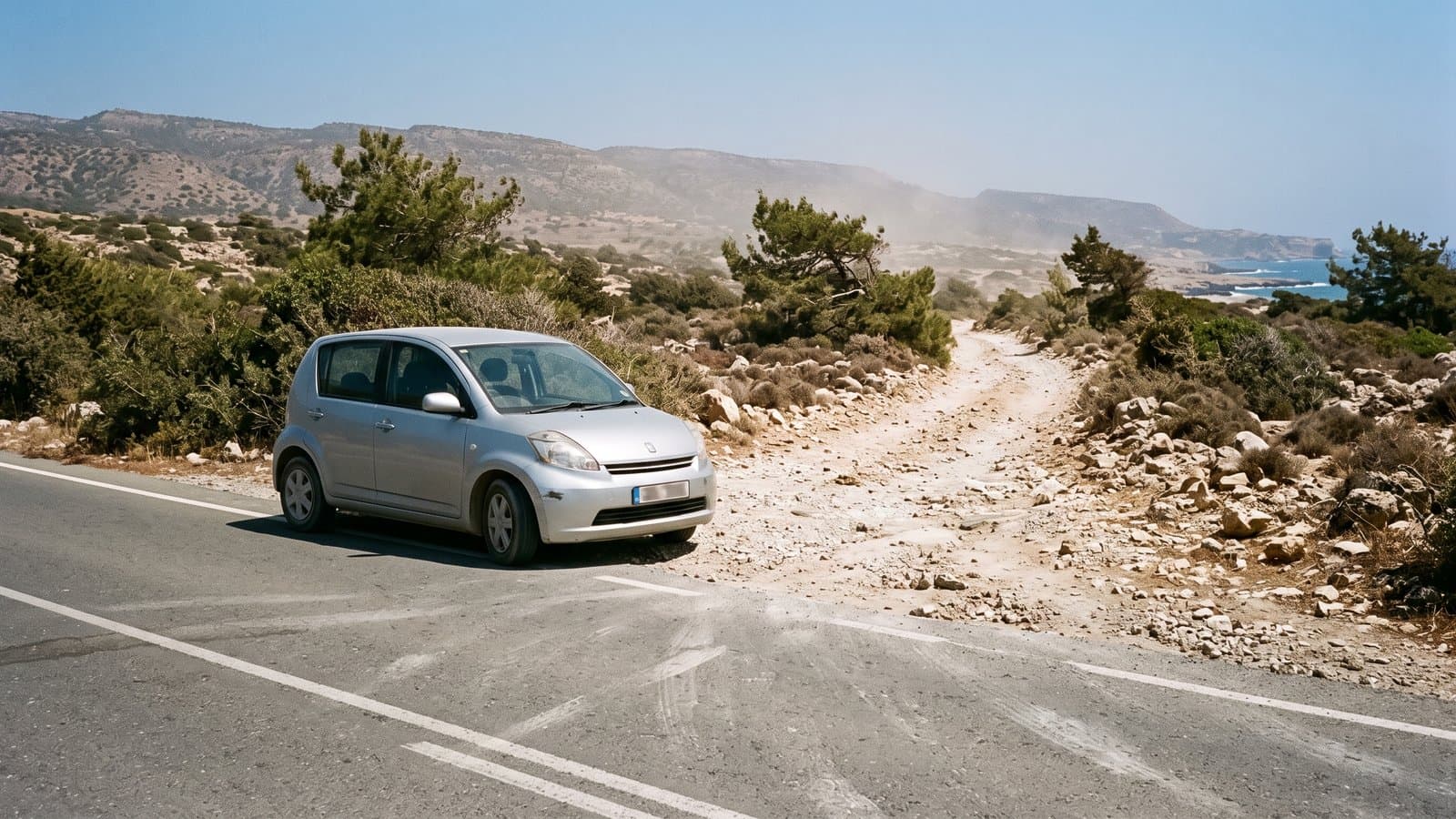
Cyprus does not warn you when a road stops being a road. A lane that runs as tarmac between two villages can lose its surface for a few hundred metres and get it back again, and a mapping app will route you down it without comment. On the Akamas peninsula, on the tracks north of Coral Bay towards Lara, and on the forest roads through Troodos, the tarmac stops and does not come back.
Every driving guide on this subject treats that as a scenery note. It is a contract term, and the reason it is missing from those pages is that the people writing them are not the ones paying for the underbody.
The Rentals in Cyprus agreement is blunt about it. Cars are for asphalt. Off-road use is charged as a fixed penalty of 450 euros per violation on a standard car such as a Note or a Mirage, and 600 euros on an SUV or a seven-seater, plus 20 euros for every started kilometre off the asphalt on the smaller class and 30 on the larger. The collision damage waiver does not rescue you either: it covers eligible bodywork and specifically excludes off-road use, along with tyres, glass, the underbody, the interior and the keys. Those are precisely the parts a dirt track damages.
There is one allowance, and it is worth knowing because it is the difference between a wrong turn and a bill. If the asphalt ends, the agreement requires you to stop and turn around, and it permits 15 metres past the end of the surface to do it safely. Past 15 metres it is a violation. The definition of off-road is written to close the argument every driver reaches for, too: it applies regardless of whether the track appears on a navigation application, is used by local vehicles, is signposted to a tourist attraction, or simply looks passable.
Read that as a description of the risk rather than as fine print with a trap in it. The exclusions are aimed at exactly the damage an unsealed road does, which is also why the damage is worth avoiding whether or not anybody is charging you for it.
If the place you want to reach genuinely is at the end of a track, the answer is a vehicle built for one, on a route agreed in advance. That is a buggy rather than a car, on an approved Akamas route, and it is a better outcome than a hatchback with a punctured sump three kilometres from the nearest tarmac.
Which places that actually applies to, and which of them are open, is its own question: what you may drive to in the Akamas, place by place sets out the Blue Lagoon, the Avakas Gorge and Lara Bay against the surface, the agreement and the current closure.
Driving up Troodos: the descent, the chains question, and the last petrol station
The climb is fine and the descent is the part to plan. There is no Cyprus snow chains law: the police restrict named roads storm by storm instead, and no petrol station is listed between Pano Platres and the top.
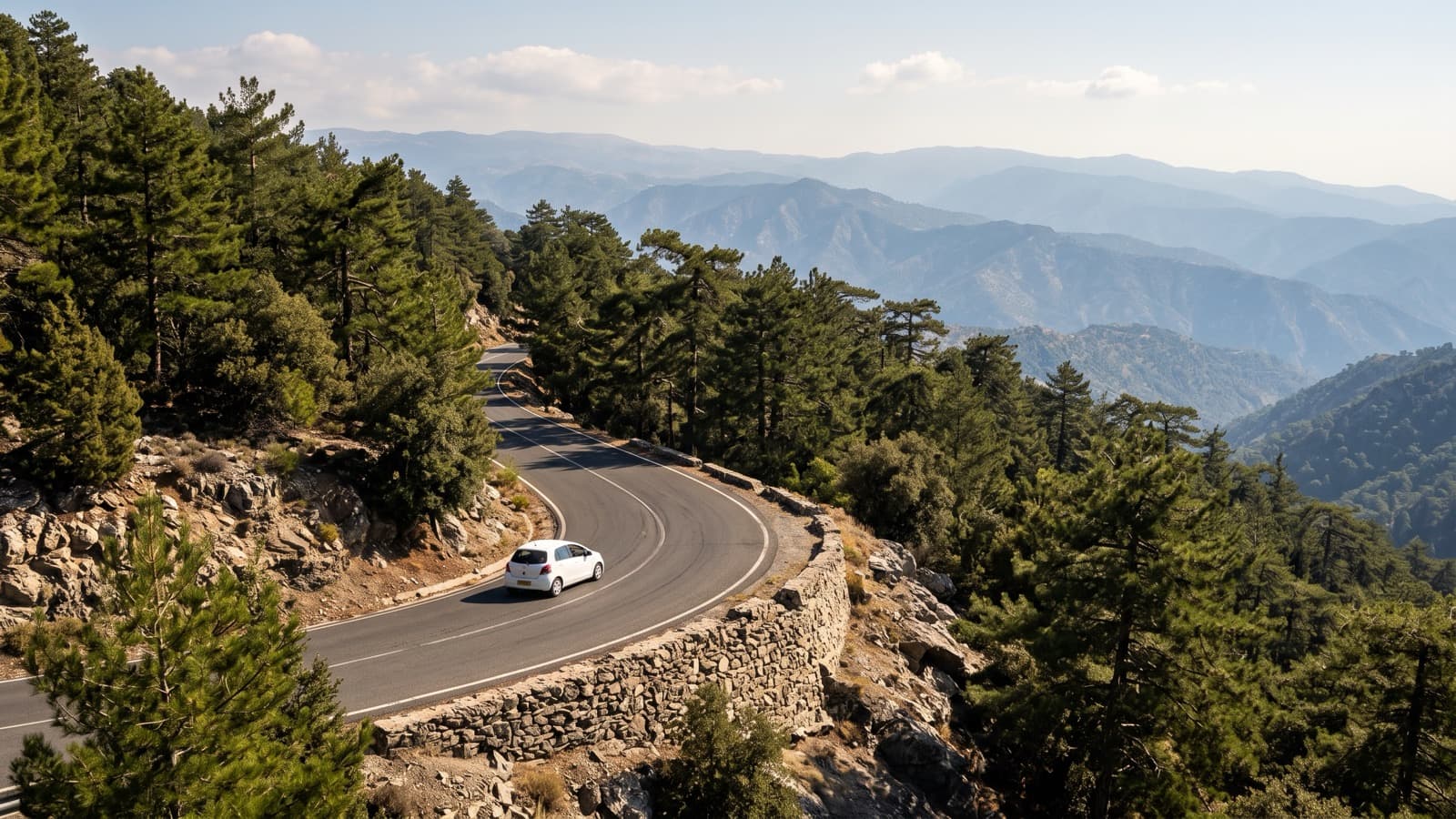
Everything written about Troodos is about going up: the hairpins, the pine forest, the view from Chionistra at 1,952 m, which is the high point of the island. Going up is fine. The car will be slow and the air conditioning will work hard, and neither of those hurts anything.
The descent is the part to plan. Holding a car on the brakes for a long continuous downhill heats them until they stop working as well, and a small hire car at its maximum load is the worst case for it. The fix is the one every driving instructor gives and almost no holiday guide repeats. Choose a low gear and let the engine hold the car, then use the brakes in firm short applications rather than resting on the pedal. In an automatic that means the manual or L position rather than leaving it in D.
The second thing about Troodos is the season, and almost everything published about it is the wrong shape. There is no Cyprus snow chains law. No instrument sets an altitude, none requires you to carry a set through the winter, and none mandates winter tyres. The consolidated Motor Vehicles and Road Traffic Regulations on the Road Transport Department's own site, and the gazetted 1984 instrument behind them, do not mention chains anywhere in 255 pages between them. Sixt's Cyprus driving page says only that spiked tyres and snow chains are permitted on mountain roads in winter, undated and unsourced, observed 6 September 2026. That is true and it answers a question nobody has.
What actually happens is that the Cyprus Police restrict individual roads, storm by storm, and they name them. On a bad morning the approaches sit in one of three states: open to all traffic but slippery, open only to vehicles with four-wheel drive or fitted with anti-skid chains, or closed to traffic altogether. The roads named every time are Platres to Troodos, Karvounas to Troodos and Prodromos to Troodos, sometimes extended to Kyperounta to Chandria and the Kakopetria to Karvounas stretch. On 25 January 2026 the Prodromos approach was restricted to four-wheel drive or chains while the other two were merely slippery, which is the detail that matters: the restriction is per road, not per mountain. On 9 February 2025 all three closed outright, for snowfall and the sheer volume of visitors together. The police publish this through their Communications Branch news service, usually as a six o'clock bulletin with updates as the day changes, and that is the thing to check on the morning rather than the night before.
The government advice that does exist is behavioural, and it is worth reading because it is better than the chains folklore. The Cyprus Highway Code, published on gov.cy on 23 May 2024, carries a section on frost and snowfall written for people driving to and from mountain areas. It tells you to check the forecast and whether the roads are open before you set out, to avoid the journey unless it is necessary, and to clear snow off the whole car including the lights, mirrors and plates rather than just the windscreen. It puts stopping distance on snow and ice at up to 10 times greater than normal. And it carries one line worth the rest put together: on a bend of a road that has been cleared of snow, there is usually ice.
Fuel is the other thing to settle before you climb, and it is a register question rather than an opinion. No petrol station is listed at Troodos Square in the government's Retail Fuel Price Observatory, and none anywhere between there and Pano Platres, checked on 6 September 2026. Coming up from Limassol the last fuel is the Petrolina in Pano Platres. From the north it is the Petrolina in Pedoulas, and from Karvounas the Petrolina in Kyperounta. That is not the same as saying there is no fuel in the mountains, because Pedoulas, Kyperounta, Kakopetria, Agros, Saittas and Trimiklini all have stations. It is that the last stretch to the top has none, and the register carries prices and addresses rather than opening hours, so treat a late afternoon arrival as a reason to have filled up already.
Nothing here is a reason to skip the mountains. The Troodos roads are the best driving on the island. They are simply the one place where a car full of luggage behaves differently from the car you tested on the motorway an hour earlier, which is worth weighing against the class you book: every car on our Paphos hire list is an automatic, and the low gear this section asks for is the L position rather than a lever.
Road signs are in Greek and English, and everything is in kilometres
Signs carry both alphabets, every distance and limit is metric, and the transliteration of place names is the part that actually causes trouble.
Cyprus posts its limits in kilometres per hour. The government road-safety leaflet gives them as 100, 80 and 50 km/h, with the 65 km/h motorway minimum alongside. For a British driver that is the single most useful line on this page: the outer ring of your speedometer is the one that matters here, and 100 on a Cyprus motorway is roughly 62 mph rather than anything like 100.
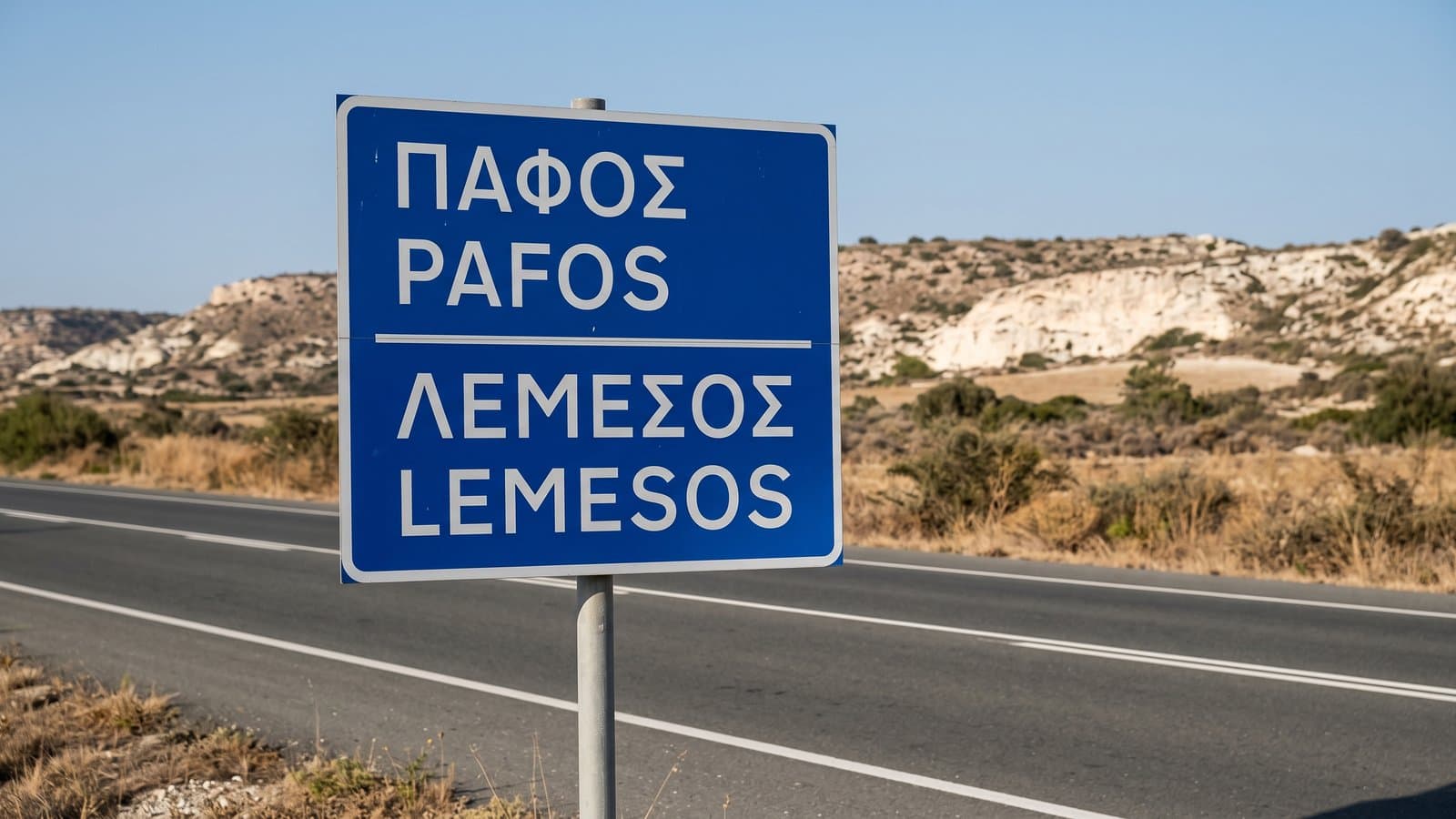
Signs are bilingual, Greek above and Latin below. The Greek is the legal version and the Latin line is a transliteration of it, which is why one village turns up with two or three spellings across the road sign, the map and your booking confirmation.
Pafos and Paphos are the same town. So are Lemesos and Limassol, Larnaka and Larnaca, Lefkosia and Nicosia. This is not sloppiness on anybody's part: the government's own English-language pages use Lefkosia and Lemesos, so the road signs and the ministry agree with each other and disagree with your airline. If a sign does not carry the name your satnav gave you, read the Greek and match the shape of the word.
One more thing about the signs, and it explains a lot about this subject. The Road Transport Department's English-language Highway Code page reads Under construction, checked 3 September 2026, and its own last-modified stamp reads 28 August 2026. There is no official English highway code online to look the rest of it up in, which is a large part of why so much of what circulates about driving here is second-hand from other rental companies. The department's road safety section is still the right place to check whether that has changed.
Driving in Cyprus for the first time: what it actually feels like
Every page on this subject says local driving is aggressive. Almost none explains the behaviour, so here is what you are actually looking at.
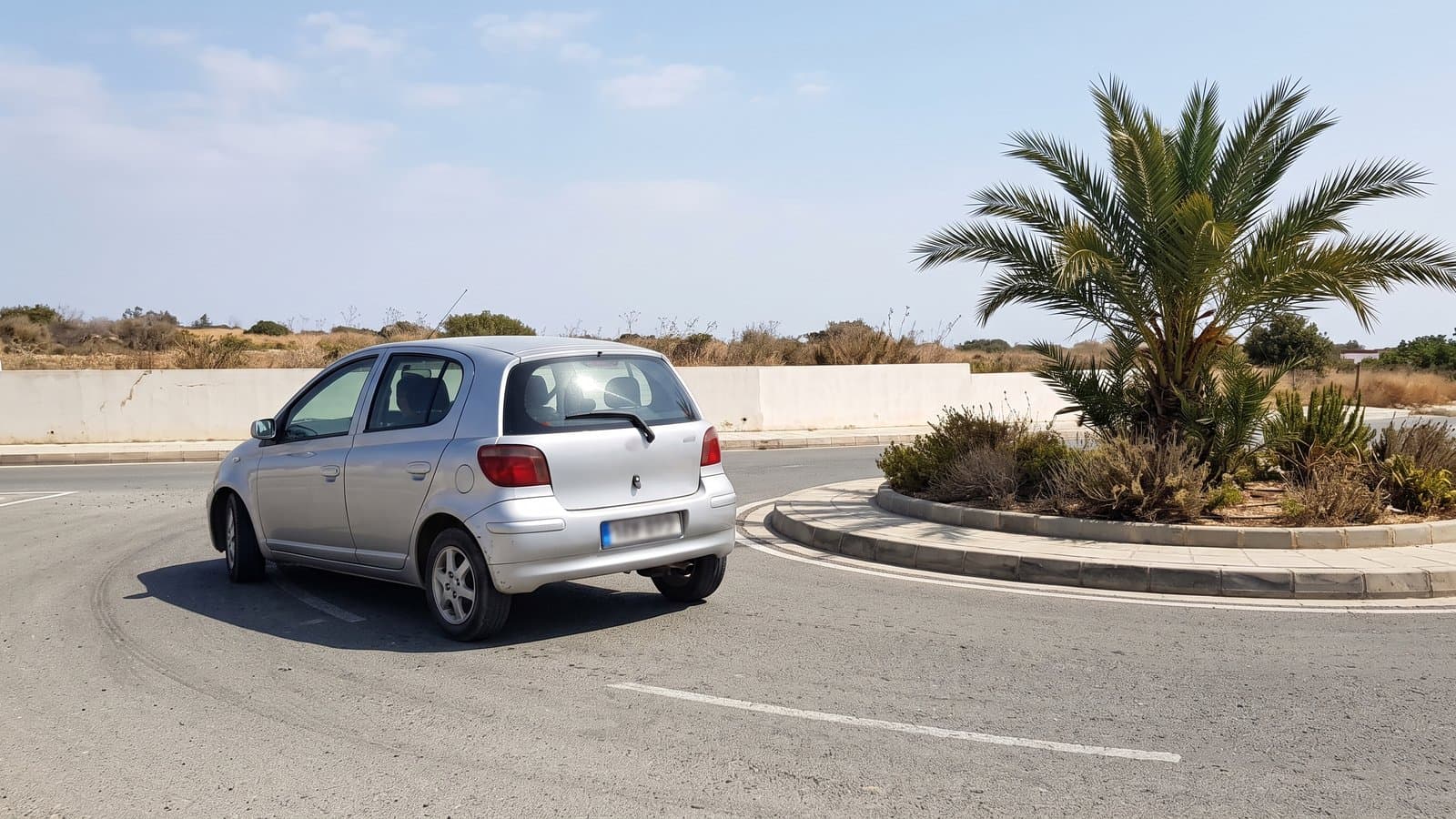
Roundabouts run clockwise. You enter to the left and give way to traffic already on the roundabout. The dread is worse than the manoeuvre, and two circuits of a quiet one on your first morning is a reasonable investment.
Unsigned junctions give priority to the vehicle coming from your right. Under left-hand traffic that feels backwards, and it is the rule most likely to produce a low-speed bump.
Motorway lanes work like the UK: sit in the left lane, use the right to overtake, to pass a blocked lane, or to let a joining vehicle in. Motorways are also closed to pedestrians, bicycles, mopeds and agricultural machines, and stopping or parking on them is prohibited, per the government road-safety leaflet.
Then the specifics, all observed on the insurance4carhire guide on 12 August 2026 and reported here as its published account rather than as law:
- Motorway slip roads that end in a 90-degree turn, some signed as low as 25 km/h off a 100 km/h road.
- Drivers straddling the centre line on minor roads to dodge broken edges and potholes. It reads as aggression. It is avoidance.
- Rush hours around 07:00 to 08:30 and again 16:30 to 18:00.
- Troodos mountain passes, where snow chains are permitted in winter.
cyprusdriving.net opens its homepage with the line that the standard of driving in Cyprus is generally poor, observed the same day. My reading of those accounts is narrower. The complaint is not really the roads. It is the variable surfaces, and the local habit of treating lane markings as advisory on anything smaller than a motorway.
For most visitors the first of these roads is the one out of the airport. If that is you, the drive from Paphos Airport into town, priced against the bus and a taxi covers that leg on its own.
Is driving in Cyprus safe?
A little worse than the European average and moving the wrong way, on the one measure that is counted the same way across every EU country. Cyprus recorded 45 road deaths in 2025. The roads themselves are not the reason.
Here is the number, from the body that counts it consistently across Europe rather than from anybody selling a car. The European Commission's road-safety figures, published 24 March 2026, put Cyprus at 46 road deaths per million inhabitants in 2025, against 42 in 2024. The EU average for 2025 was 43. Deaths across the EU fell by 3% that year while the Cypriot rate rose by 10%. Those are preliminary figures and the Commission publishes the final set in the autumn, so read them as the shape of the trend rather than as a settled total.
The Cypriot count behind it comes from the police, who run the collision register themselves. Their traffic statistics record 45 deaths in 2025, 41 in 2024, 34 in 2023, 37 in 2022 and 45 in 2021. That is 202 people over five years. These are not two independent measurements that happen to agree: the Commission publishes a rate per million inhabitants and this is the national count underneath it. What the register adds is everything below that one number.
So: a little above the European average, on a curve pointing the wrong way, in a year when most of Europe improved. That is worth knowing before you drive and it is not a reason to cancel the car.
What the register cannot tell you is the part you actually asked about. It is not broken down by resident against visitor, and it is not broken down by road class, so no figure in it can be attributed to hire cars, to tourists, or to the motorway rather than the coast road. What it does rule out is the two answers this question usually gets. Cyprus is not unusually dangerous, and it is not the effortless drive the brochures describe either.
The honest read is that the risk here sits in behaviour and in unfamiliarity rather than in the surface. The roads between the towns are good. The things that catch visitors out are the right turn across traffic, the unsigned junction that gives priority from a side you are not watching, and the long descent taken on the brakes. All three have a section on this page, and none of them is about the tarmac. The register agrees with that reading, and the next section is where it does.
Where, when and who: what the police register actually shows
Over 2021 to 2025 the register records 192 fatal collisions and 202 deaths. A third of the dead were on two wheels, the weekend carries 38.5 per cent of fatal collisions, and Limassol district records more road deaths than any other. The register publishes no population or traffic figures, so it ranks districts by count and not by risk.
Who dies on Cypriot roads
road deaths, 2021 to 2025 combined
Show these figures as a table
| Road user | Deaths, 2021 to 2025 |
|---|---|
| Drivers | 69 |
| M/cyclists | 52 |
| Pedestr. | 38 |
| Car pass. | 24 |
| Cyclists | 10 |
| Mopeds | 3 |
| M/c pass. | 3 |
| Wheelchair | 2 |
| E-scooter | 1 |
| District | 2021 | 2022 | 2023 | 2024 | 2025 | Five-year deaths |
|---|---|---|---|---|---|---|
| Limassol | 9 | 14 | 9 | 10 | 15 | 57 |
| Nicosia | 14 | 8 | 7 | 11 | 11 | 51 |
| Larnaca | 6 | 6 | 10 | 10 | 10 | 42 |
| Paphos | 9 | 4 | 5 | 1 | 6 | 25 |
| Famagusta | 6 | 5 | 3 | 6 | 2 | 22 |
| Morphou | 1 | 0 | 0 | 3 | 1 | 5 |
| All districts | 45 | 37 | 34 | 41 | 45 | 202 |
This is the register itself rather than a summary of it. The Cyprus Police publish their traffic statistics as workbooks at the force's own page on gov.cy, sourced to the Computerized System for Traffic Collisions and issued by its Strategy and Change Management Directorate. Everything in this section is read from the 2021 to 2025 and first-half-2026 files, on 8 September 2026. Nobody else writing about driving here appears to quote them.
Deaths by district first, because it is the cut people expect and the one most likely to surprise them.
- Read this table as counts, not as a safety ranking. The register carries no population, no vehicle numbers and no distance driven, so it cannot say where the risk per driver or per kilometre is higher. Limassol and Nicosia are the two largest districts by population and they head the table; that is close to what a table with no denominator would look like whatever the risk actually was.
- Limassol records the most road deaths of any district, 57 over five years, and its 2025 figure of 15 is the highest single district-year in the series.
- Paphos records 25 deaths over the five years. That is fourth of the six districts, below Larnaca and above Famagusta, which covers Ayia Napa and Protaras and records 22.
- Paphos's 2024 figure of 1 is the lowest single year any of the four largest districts recorded. One year that low in a district that size is as likely to be chance as improvement, and 2025 was back to 6, so read the five-year column rather than any one cell.
- The district a death is recorded in is where the collision happened, not where anybody lives. It says nothing about who was driving.
The 2025 collision figures are not comparable with 2024, and the file says so
Add the two-wheeled classes together and the number is the one I would want a customer to see before they choose a scooter over a car. Motorcyclists alone are 52 of the 202 dead, a quarter of the total. With moped riders, pillion passengers, the e-scooter rider and the cyclists, 69 people of 202 died on two wheels: a third of all road deaths, in a country where two wheels are a small fraction of the traffic. 2025 was the worst motorcyclist year in the series at 17, up from 10 the year before.
The first half of 2026 has not improved it. The police's interim file records 20 fatal collisions and 20 deaths to 30 June, of whom 8 were motorcyclists, 40 per cent, and 6 of those 8 died in Nicosia district.
That paragraph costs the company I work for something, because it hires out scooters and buggies. It is here because it is what the register says, and a reader deciding between a car and two wheels for a week on this island deserves the number rather than a sentence of holiday copy.
When matters as much as who, and this is the cut the register publishes that nobody joins to a visitor's week. Fatal collisions concentrate on the weekend and after dark: Saturday and Sunday account for 74 of 192 fatal collisions, 38.5 per cent on two days of seven, with Saturday alone the worst day at 42. Thursday is the safest at 15. By time of day, the eight hours from 20:00 to 03:59 hold 69 of 192, a little under 36 per cent, and the single worst four-hour band is 16:00 to 19:59 at 40.
The causes are the last cut, and two of them are on this page for a reason. Careless driving heads the list at 36 of 192 fatal collisions. Alcohol appears in 34 once the alcohol-only and alcohol-with-drugs rows are added, which is more than any single named cause. And the right turn accounts for 18, the same weight as speed. That is the manoeuvre that crosses oncoming traffic in a left-hand-traffic country, and it is the one I said above catches visitors rather than the roundabouts. The register puts a number on it.
Of the 95 drivers and car passengers killed, 44 were not wearing a seat belt and 31 were. The register does not know for 17 of them, and 3 were not obliged to wear one, so the honest version is that of the 75 cases where belt use is recorded, 44 were unbelted. The helmet table needs more care and is worth stating plainly rather than quietly dropping: of the 17 riders and pillions killed in 2025, 13 were wearing a helmet. That is not an argument against helmets, and it is not evidence about how well they work. The register records whether a helmet was worn, not whether it prevented anything, and a table built only from people who died carries no comparison group of riders who crashed and survived. Across the five years it logs 31 helmeted deaths against 22 unhelmeted and 5 unknown, which is a count of the dead and not a measure of protection.
Seat belts, child seats and helmets
Seat belts are compulsory in every seat, front and rear.
The child rule is where the guides fall apart. The government road-safety leaflet sets a height threshold: a child under 1.5 metres must wear a suitable seat belt or use a suitable restraint. The three competitor pages that cover this give three different age-based rules instead, ranging from under-4s to under-12s, observed 12 August 2026. I follow the leaflet, because it is the primary source and it is the one a police officer is working from.
Practical consequence for parents: book the seat, or bring it. Do not assume the car comes with one.
On two wheels, three rules that appear in none of the five pages I compared:
- Helmets are required for rider and passenger, and agencies should supply them on request.
- A pillion passenger must be over 12 and must sit astride the machine.
- A motorcycle keeps its headlight on during the day.
Smoking in a car with anyone under 16 aboard is also banned, per the RAC and Sixt guides, observed 12 August 2026. I have not been able to reach the Cyprus statute behind it, so that one is their published position rather than a figure I can source to the government.
Crossing the Green Line: your Cyprus insurance stops at the buffer zone
Your Republic of Cyprus cover stops at the line, which makes the crossing an insurance event rather than a scenic detour. The Green Line itself is a United Nations buffer zone running across the island, and not a border to treat casually.
FCDO travel advice puts it plainly. Cars hired in the Republic of Cyprus often have no insurance cover in the north of the island, and you will not be allowed through a crossing without the correct insurance documents. At some crossing points, including Agios Dometios, you can buy cover for the north.
What nobody tells you is what that cover does. It is third-party liability only. It pays for damage you do to other people. It does nothing for damage to the hire car, nothing for theft of it, and nothing for recovering it. Your excess protection does not travel either, so a scratch on the far side of the line is yours.
What the excess actually is, and when cover is worth buying, has its own page now: the car hire excess and collision damage waiver guide, which also works through what a crossing-booth policy does and does not do.
Ask before you plan the day, not at the checkpoint
Fines, penalty points and how they are actually paid
Money first, points second, and the money is arithmetic rather than a flat ticket.
| Offence | Penalty |
|---|---|
| Speeding | 2 euros per km/h to 30% over, 3 euros to 50%, 5 euros to 75%, court above |
| Speeding, in court | Up to 4,000 euros and up to one year |
| Speeding combined with alcohol or drugs, in court | Up to 15,000 euros and up to four years |
| Illegal parking, eating or drinking at the wheel | On-the-spot settlement, commonly quoted at 85 euros |
A police officer can issue on the spot, but you do not pay at the roadside. The charge is settled out of court through the government payment channels, with JCCsmart the commonly used processor, and the amount escalates if you leave it. Published sources disagree on the escalation window, quoting 15, 30 and 90 days, so treat the mechanism as the rule and the deadline as unknown.
Cyprus operates a penalty points system alongside the money, and the government tables confirm the system exists. A points ceiling and a recent change date circulate widely in secondary sources. I am leaving both out until a government source states them.
One thing visitors underestimate: a camera fine can reach you weeks after your flight home, through the hire company, with an administration fee attached.
Fuel, parking and the small practical things
Fuel is unleaded 95, unleaded 98 and diesel. LPG is not available at ordinary stations, and carrying petrol in a can is illegal.
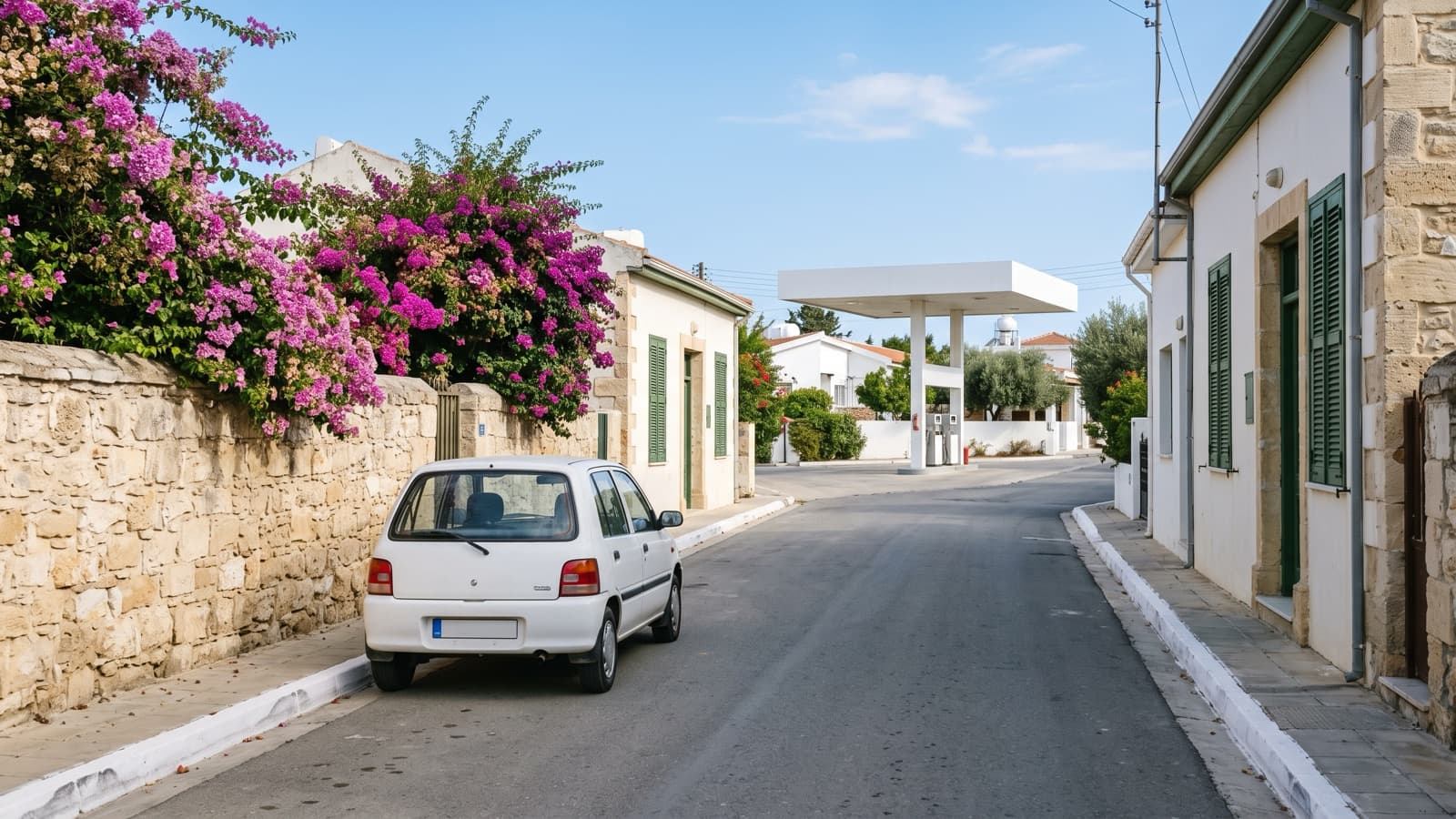
Prices move too fast for a guide to be useful. So rather than print a figure that will be wrong in a fortnight, I am pointing you at the Retail Fuel Price Observatory, which is the official source for current pump prices in Cyprus. It is read every morning for the fuel price tracker on this site, which is the version of this answer I would actually use: the average for each district, the cheapest and dearest pump in it, the number of stations behind the figure and the date it was read. Two things on it are worth knowing before you fill up. Diesel has cost more per litre than unleaded 95 here every week since 19 June 2023, so a diesel is not the cheaper car to run. And Paphos district reads dearest while Nicosia reads cheapest, inside a spread of roughly 17 cents a litre across the whole island. On the pumps themselves the published accounts differ: Orbit Car Hire says Cypriot stations are attended, while RAC describes automatic card pumps, both observed 12 August 2026. Carry a card and some cash and be ready for either.
Parking, in one line each:
- Single yellow line: no parking.
- Double yellow line: no stopping or waiting.
- Town centres: metered bays, and an on-the-spot fine if you get it wrong.
- Foreign disabled badges are recognised.
Two more, quickly. The island is small enough to cross in a day, which is the whole argument for hiring a car at all. That argument belongs on its own page rather than this one. And the British Sovereign Base Areas at Akrotiri and Dhekelia are policed separately from the Republic, which nothing else on this subject seems to mention in any language.
If you have an accident in Cyprus
Call 199 or 112, and leave the vehicle where it stopped. The government road-safety leaflet gives both numbers; every competitor page gives only 112.
- Call 199 or 112. The government leaflet gives both numbers. Every competitor page gives only 112.
- Leave the vehicle where it stopped. The insurance4carhire guide, observed 12 August 2026, says moving it after even a minor knock can leave you liable. I could not confirm that at a primary source, so treat it as their published position and a good reason to wait.
- Photograph everything. Include the other vehicle and the road layout, and take the other driver's details.
- Telephone the hire company. Do it before anything is moved or repaired.
The police must be called to a traffic accident. Your exposure is the excess on your agreement, so know that number before you drive.
Rentals in Cyprus will tell you what its own agreement requires in an accident. Ask on the day you book, not on the hard shoulder.
Who this is for, and what you will need
I wrote this for the visitor collecting a hire car at Paphos or Larnaca who has never driven on this island. Before you set off:
- Your original licence, not a photocopy. A photocard travels better than a paper licence.
- The card the booking was made on, because the desk will want it.
- Two warning triangles in the boot. Published sources disagree on one or two, so pack two.
- Your hire agreement, read once. Age limits, unsealed roads and the Green Line are contract terms rather than law, and all three cost money to get wrong.
Sources
Primary sources are linked at each claim above. Compiled from: the Cyprus road-safety leaflet on gov.cy, published by the Cyprus Tourism Organisation with the Cyprus Police, the Ministry of Communications and Works and the Cyprus Car Hire Associations; the Cyprus Highway Code published on gov.cy on 23 May 2024, including its frost and snowfall section; the consolidated Motor Vehicles and Road Traffic Regulations on the Road Transport Department's site and the gazetted 1984 instrument behind them, both checked for a snow chains provision and carrying none; dated Cyprus Police Communications Branch road-status announcements from February 2025 to March 2026; the Road Safety Cyprus penalty tables; FCDO travel advice for Cyprus; the Retail Fuel Price Observatory, queried 6 September 2026; the Road Transport Department Highway Code index; the Public Works Department's own page on gov.cy; the Public Works Department's December 2012 road-network report to the European Commission; the European Commission's road-safety figures published 24 March 2026; and the Cyprus Police traffic-collision register, its 2021 to 2025 and first-half-2026 workbooks, read 8 September 2026.

Written by Paul Bendzik, a manager at Rentals in Cyprus, based in Limassol
He manages Rents in Cyprus LTD, the company that publishes this site, and he hands cars over to visitors most weeks. This page is still built from published government sources rather than from memory: it states what the road-safety leaflet and the penalty tables say, names each source, and dates every check. Where the sources disagree, both figures are shown. Where no primary source could be reached, the number is left out and that is said in the text.
Dated observations from published commercial pages are named where used: RAC, Sixt, Orbit Car Hire, insurance4carhire and Auto Europe. Those are quoted, not endorsed, and not linked. Cyprus Police road-status announcements are published through the force's Communications Branch news service rather than on a gov.cy address, so they are quoted and attributed here rather than linked.